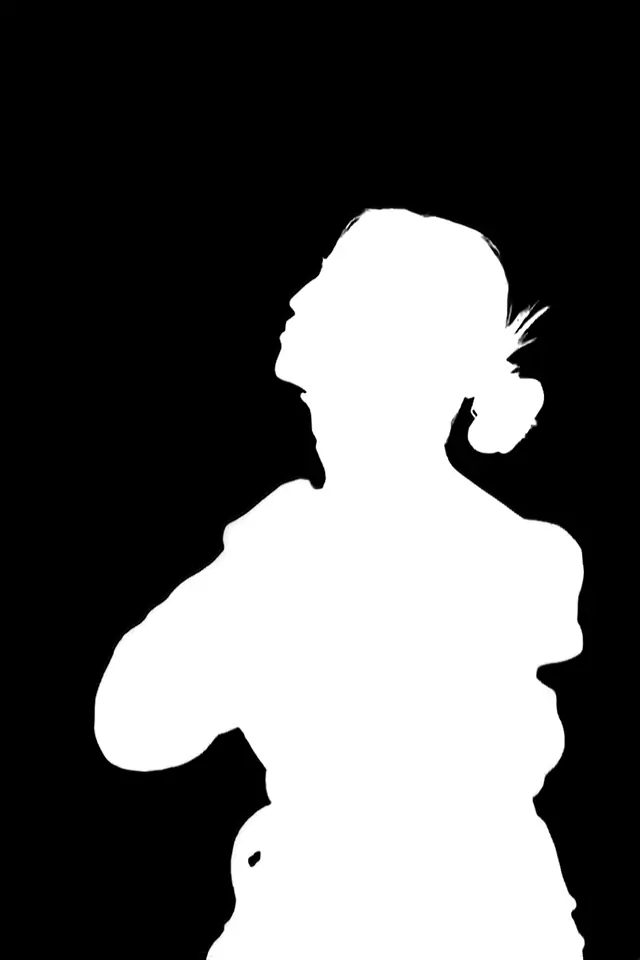

Foreground segmentation and background removal are often used as if they mean the same thing. They are close relatives, but one is a vision task and the other is an image operation. Mixing them together makes it harder to explain why a good mask can produce a bad PNG or why the same mask can create several perfectly valid outputs.
Foreground segmentation asks which parts of an image belong to the foreground. Background removal takes that answer, decides what to do with everything else, and packages the result: transparent pixels, a white background, a colored canvas, a standalone mask, or something more specialized.
The distinction may sound academic until a pipeline leaves a halo, loses a shadow, or returns JPEG when the designer expected transparency. Then it becomes a very practical way to locate the mistake.
The clean distinction
Segmentation decides. Background removal applies the decision.
- Segmentation produces labels, scores, a mask, or an alpha-like prediction.
- Background removal uses that prediction to alter visibility or replace the background.
- User intent determines which objects, props, holes, and shadows count as foreground.
- Output format and compositing remain capable of breaking an otherwise good prediction.
- Keeping the stages separate makes testing and debugging much less mysterious.
01
Two related jobs, two different deliverables
| Question | Foreground segmentation | Background removal |
|---|---|---|
| Primary job | Estimate what belongs to foreground | Create an image that excludes or replaces background |
| Typical input | Decoded image tensor | Image plus a segmentation or matting result |
| Typical output | Mask, logits, probabilities, or labels | Transparent cutout, flattened image, or exported mask |
| Main quality concern | Subject coverage and boundary accuracy | Usability of the final pixels in the destination |
| Can the same result vary? | One prediction can be thresholded or refined in different ways | One mask can produce transparent, white, colored, or effect-driven outputs |
Real systems often combine these stages behind one endpoint. The conceptual separation still helps even when the user sees only one button.
Dichotomous image segmentation, the task discussed in the BEN paper, focuses on separating complex foreground objects from their backgrounds in real images. It produces the information needed for background removal, but the paper’s final segmentation mask is not by itself every product decision involved in exporting a usable asset.
02
Segmentation produces a spatial decision
At its simplest, a foreground mask gives each pixel one of two labels: foreground or background. Many models first produce continuous logits or confidence values. A later threshold, refinement stage, or matting process turns those values into the mask used downstream.
Raw model scores
Unbounded values emitted by a network before a sigmoid or other mapping. Useful internally, not something most image editors want for lunch.
Foreground confidence
A value between 0 and 1 that expresses the model’s foreground preference under its learned policy.
Hard mask
A yes-or-no decision for each pixel. Efficient and clear, but too blunt for genuinely mixed boundary pixels.
Soft mask
Intermediate values preserve partial transitions and can function as alpha or guide a later refinement stage.
The model does not normally label pixels in isolation. It uses nearby detail and broader context to infer objects, interior holes, attached parts, and occlusion. That is why a locally ambiguous edge can still be predicted well and why an unfamiliar scene can lead context in the wrong direction.
03
Background removal turns the map into pixels
Once a pipeline has a foreground estimate, it can use that estimate in several ways. A transparent result copies or estimates foreground colors into RGB channels and writes the mask or matte into alpha. A white-background result composites those foreground colors over white. A mask-only result exports the spatial decision for somebody else to use.
These derivatives are not interchangeable. JPEG does not preserve transparency. A PNG can contain either RGB or RGBA. A white composite throws away the option to place the subject over black later. A standalone mask may be more valuable than a cutout when another system wants to control color decontamination and compositing.
A checkerboard is a preview, not an image property
Editors draw a checkerboard to make transparent areas visible. The squares are not hiding inside the PNG, waiting to surprise your storefront.
04
The hard part often starts before the pixels
A foreground policy describes what the system should keep. For a portrait, the person, clothing, hair, and an object held in the hands may belong together. For a product listing, a hand holding the item may be unwanted. A lifestyle image may need several products kept as one group. None of these choices is universally correct.
Questions the word “foreground” leaves unanswered
- Should a cast shadow remain, become partially transparent, or disappear?
- Are props touching the product part of the subject?
- Should all people remain, or only a primary person?
- Do reflections inside a glossy product belong to its appearance?
- Should holes through the subject reveal the new background?
- What happens when the subject exits the frame?
Training annotations answer these questions at scale, whether the team writes the policy down or not. Production workflows should make the answer explicit enough that reviewers can distinguish a model error from a mismatch in expectations.
05
Matting bridges a hard label and a usable edge
Binary segmentation is a good fit for solid regions with clear boundaries. Around hair, smoke, transparent material, antialiasing, or motion blur, one pixel may contain both foreground and background light. Image matting estimates partial opacity rather than forcing an immediate hard label.
A trimap is a common guide: definite foreground, definite background, and an unknown region where a matting model should work out the transition. In the BEN research architecture we published, that guide is created automatically from the base model’s confidence. Sigmoid confidence values at or above 0.95 become foreground, values at or below 0.05 become background, and the rest become unknown for BEN Refiner.
Research connection
Confidence-Guided Matting joins segmentation and refinement
06
The distinction makes failures easier to debug
If part of the subject is absent from the mask, the problem is likely selection, segmentation, or refinement. If the mask is correct but the final cutout has a white fringe, inspect foreground color and alpha compositing. If transparency is gone entirely, inspect the requested channels and output format before retraining anything.
| Visible symptom | Likely layer | First thing to inspect |
|---|---|---|
| Wrong object kept | Foreground policy / segmentation | Source, intended subject, and raw confidence |
| Thin detail missing | Resolution / segmentation / refinement | Source crop and pre-resize working image |
| Hard, clipped hair | Mask threshold / matting | Soft prediction or alpha values |
| Light or dark halo | Color decontamination / compositing | RGBA edge on contrasting backgrounds |
| Transparent result becomes opaque | Encoding / delivery | Output format and channel count |
| Edge shifts after resize | Postprocessing | Mask-to-source coordinate mapping |
Saving intermediate artifacts during evaluation is unusually helpful. A source, confidence map, final mask, RGBA cutout, and a couple of composites can turn “the API made it weird” into a specific and fixable report.
07
Choose the deliverable from the next step
If the next system only accepts marketplace-ready JPEGs, an opaque white composite may be the correct final output. If a design team will reuse the subject across layouts, preserve RGBA. If another computer-vision stage needs geometry, a mask may be the cleanest contract. If the boundary contains real partial opacity, keep enough precision for a matte.
Segmentation answers “where is it?” Background removal answers “what should this image become now that we know?”
The distinction in one line
Related distinction
Next, separate segmentation from image matting.
Foreground segmentation explains the broad decision. Matting explains why the pixels around hair, blur, glass, and soft edges need more than a hard yes or no.
Read image matting vs segmentation